AML Policy at BC Poker – Anti-Money Laundering Standards and Compliance Framework

BC Poker AML Policy establishes standards designed to prevent unlawful financial activity within the platform ecosystem. Anti-Money Laundering procedures are important for online poker operations because account funding, wallet activity, payment processing, and withdrawal requests create compliance obligations. BC Poker operates under an Anjouan Gaming License and follows AML/CFT requirements connected with licensed gaming activity. Platform rules prohibit the use of funds associated with criminal conduct, unauthorized activity, or illegal financial sources. These standards apply across supported cryptocurrency and fiat payment operations.
BC Poker security shield icon representing account protection and platform safety.
CDD Verification
AML Monitoring
CFT Compliance
PoR Reserves
FATF Standards

Customer Due Diligence (CDD) on BCPoker – How the Platform Verifies Users

BC Poker Online Customer Due Diligence procedures operate as a central AML mechanism within account security and risk management systems. CDD can include identity checks, account ownership verification, payment review, transaction assessment, and source-of-funds requests where elevated risk indicators exist. BC Poker uses a risk-based approach that allows standard onboarding instead of requiring mandatory verification during every registration process. Additional checks can appear when account behavior creates compliance triggers or operational concerns. This structure helps maintain financial integrity and account protection standards.

Compliance Reference Verified Information
License Type Anjouan Gaming License
Verification Structure Risk-based model
Review Method Escalation through risk indicators
Compliance Scope AML/CFT requirements

BC Poker payment operations may involve external providers that perform their own transaction screening procedures. Accurate account information can help reduce delays connected with verification workflows. Consistent profile details support smoother financial activity and payment processing.

Monitoring

Transaction Monitoring on BC Poker How Suspicious Activity Is Detected

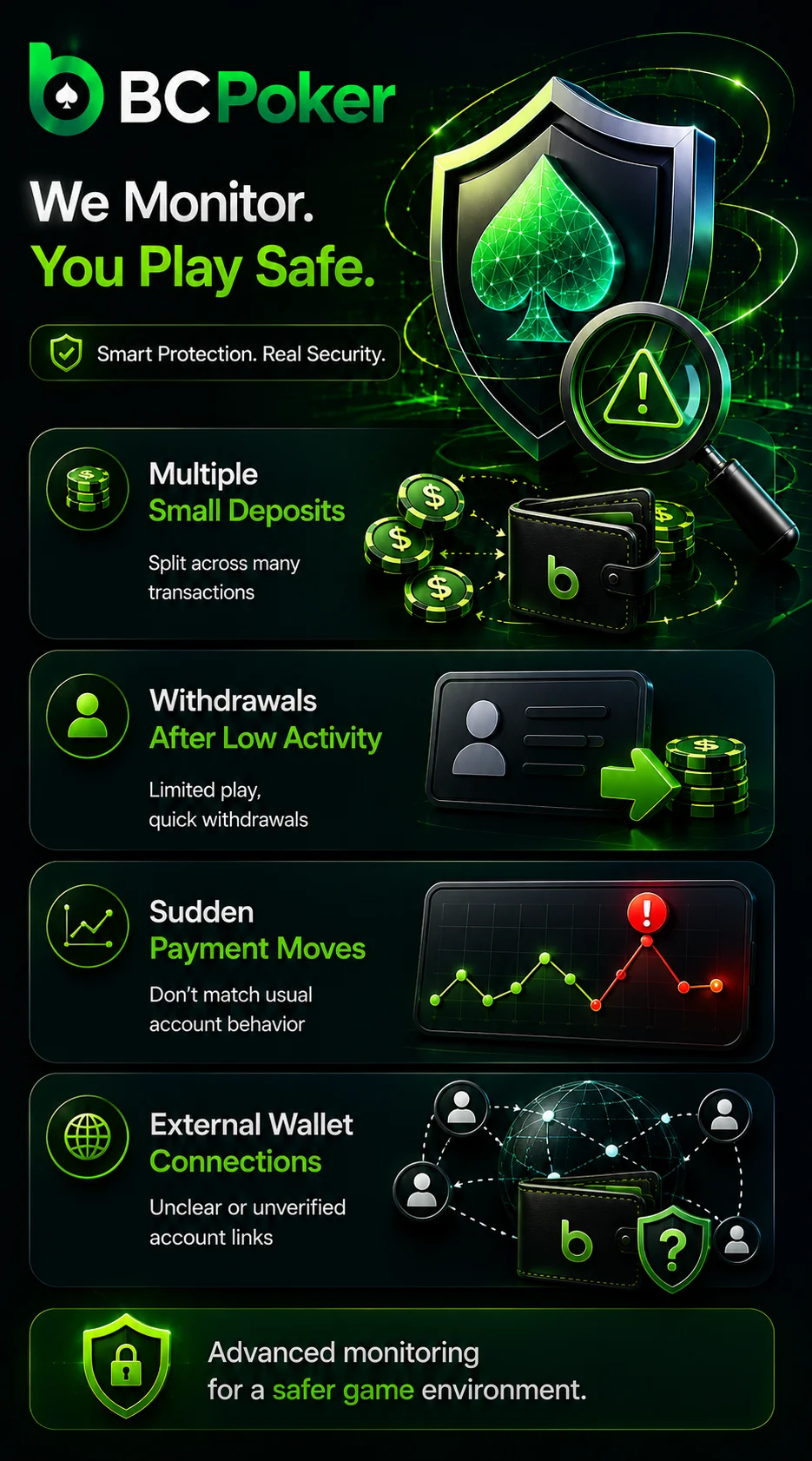
BC Poker transaction monitoring functions as a dedicated risk-control process designed to identify suspicious payment behavior and unusual account activity. Internal systems compare account movement patterns instead of evaluating isolated payment events separately. Review tools analyze transaction timing, account interaction, wallet behavior, and payment characteristics connected with financial operations. Multiple signals usually create stronger risk indicators than one isolated activity event. This structure supports broader fraud detection and financial crime prevention procedures. Monitoring systems can identify several operational indicators:

repeated small deposits distributed across multiple transactions;

withdrawal activity following limited account engagement;

sudden payment movement inconsistent with established account behavior;

external wallet interactions with unclear account connection.

BC Poker security monitoring for deposits, withdrawals and wallet verification.

BC Poker risk specialists may perform manual analysis before applying payment restrictions or account limitations. Internal review procedures focus on account consistency and transaction legitimacy during investigation stages.

Blockchain Transactions and AML on BCPoker – Crypto Compliance

BC Poker blockchain compliance procedures apply dedicated monitoring standards because cryptocurrency operations function differently from traditional payment environments. Public blockchain records can support wallet analysis, payment tracking, and financial review processes. Blockchain visibility creates a transaction history that remains accessible after network confirmation. This structure assists compliance specialists during cryptocurrency-related investigations and account assessment procedures. BC Poker also uses a Proof of Reserves model for customer asset coverage.

Crypto Infrastructure Element Technical Detail
Asset verification model Proof of Reserves
User reserve coverage 1:1 backed balances
Shuffle verification technology KECCAK-256
Asset storage structure Separate corporate holdings

BC Poker also considers FATF virtual asset requirements during broader AML review processes. International compliance classifications and jurisdiction obligations can affect account availability conditions.

Restricted Funds

Prohibited Funds and Restricted Jurisdictions on BC Poker

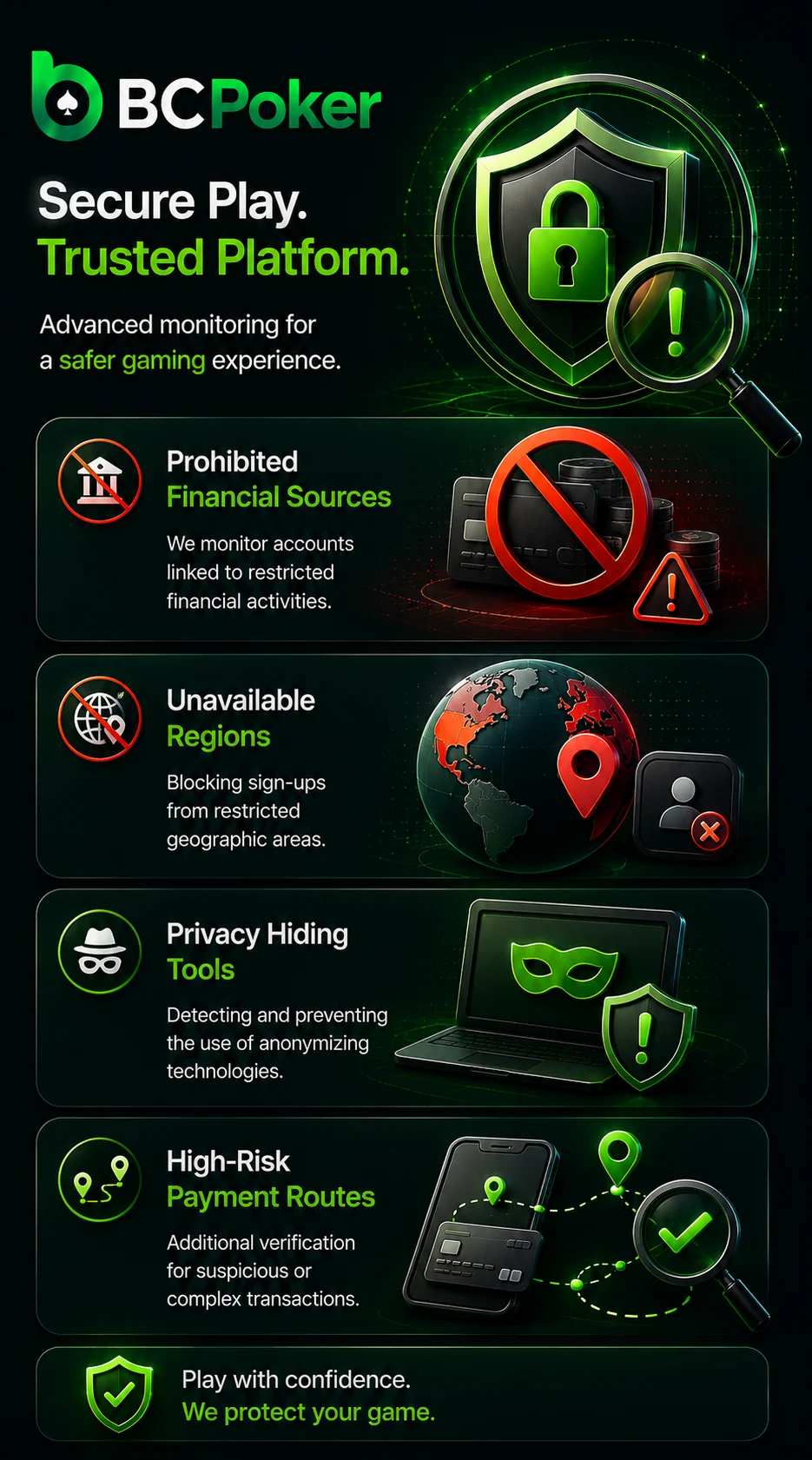
BC Poker prohibited funds rules define compliance boundaries for financial activity and account use. Assets connected with criminal conduct, unauthorized operations, unlawful transactions, or prohibited payment sources cannot be used on the platform. These standards apply during registration, account activity, payment processing, and withdrawal requests. Jurisdiction controls may also depend on licensing obligations and account location indicators. Geographic requirements can change because international regulatory frameworks evolve over time. Access reviews can include these situations:

account activity connected with prohibited financial sources;

registration attempts from unavailable regions;

use of tools designed to hide geographic information;

payment routes requiring additional verification.

BC Poker compliance monitoring for restricted regions, payment checks and account security.

BC Poker compliance systems support regulatory responsibilities and operational integrity requirements. Attempts to hide account location or payment origin may create additional investigation procedures.

Account Blocking and Fund Freezing – BCPoker AML Enforcement Procedures

BC Poker AML enforcement procedures define actions available during account investigations and compliance reviews. Restriction measures can affect payment functionality, transaction processing, withdrawal access, and account operations. Internal investigations are handled by risk management specialists rather than relying only on automated controls. Manual review allows deeper evaluation of transaction context and broader account behavior patterns. Investigation outcomes depend on account history and submitted information.

Players should follow these steps.

  1. Contact Live Chat or [email protected] and explain the account issue.
  2. Submit requested documents related to verification requirements.
  3. Provide additional financial information if a review requests it.
  4. Wait until the risk team completes the assessment process.

BC Poker support procedures may require specific documentation depending on account circumstances. Repeated submissions before review completion can slow communication processes.

FAQ

BC Poker FAQ

Answers to the most common questions about BC Poker online.

Yes. BC Poker can request additional verification information when account activity changes over time. New payment patterns or operational monitoring indicators may create another review stage. Requests depend on account risk profile and compliance assessment procedures. Verification requirements can vary across individual situations.

Yes. BC Poker can evaluate operational behavior indicators during compliance procedures and internal risk assessment workflows. Transaction structure, payment timing, and account activity may become part of broader monitoring analysis. Reviews support financial integrity procedures and account assessment processes. Individual circumstances determine review scope.

Yes. BC Poker can assess cryptocurrency transactions connected with account operations and payment activity. Public blockchain visibility can support wallet analysis during compliance investigations. Reviews focus on payment consistency and account-related indicators. Additional information may be requested when review procedures require it.

BC Poker uses jurisdiction controls because regulatory obligations and compliance standards differ between regions. Licensing requirements can affect where services remain available. These restrictions support broader AML/CFT responsibilities and account protection procedures. Access availability depends on current compliance conditions and operational requirements.